Condo vs. Townhouse vs. Single-Family Home: What's Really Different
By Jiffy Rozario · · 6 min read
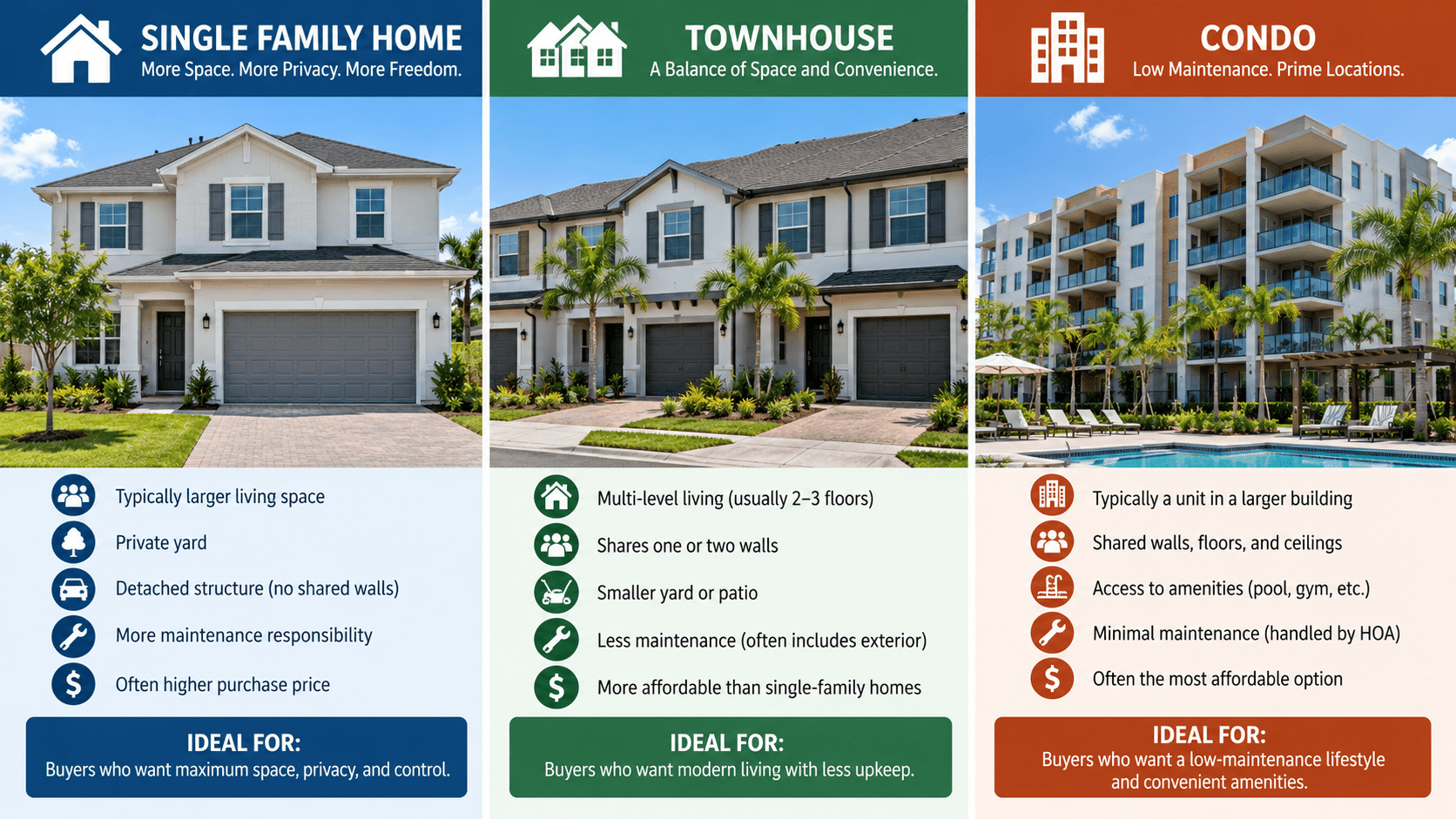
"Condo, townhouse, and single-family home are three different kinds of ownership, and the difference comes down to one question: what exactly do you own, and what does someone else own on your behalf? Here's how they actually compare.
Single-family home: you own everything
With a single-family home, you own the structure and the land it sits on, with no shared walls and (usually) no HOA telling you what to do with your own exterior — though some single-family communities do have an HOA for shared amenities. You're responsible for all of your own maintenance: roof, exterior, landscaping, everything.
Townhouse: you own the building, sometimes the land
With a townhouse, like the two floor plans at Lakeside Landing, you own your unit's structure and often a small piece of land, but it's attached to your neighbor's home on one or both sides. You're still responsible for your own interior and exterior maintenance, but a homeowners' association usually maintains shared amenities — a pool, a playground, common landscaping — for a monthly fee.
Condo: you own the interior, the HOA owns the building
With a condominium, you typically own only the interior space of your unit — the walls in, essentially — while a condo association owns and maintains the building structure itself: the roof, exterior walls, and often the windows. Condo fees tend to be higher than townhouse HOA fees because they're covering more — building insurance and structural maintenance, not just landscaping and amenities.


Side-by-side comparison
Single-Family | Townhouse | Condo | |
|---|---|---|---|
Own the land? | Yes | Often, a small piece | Rarely |
Own the building structure? | Yes, entirely | Yes, your unit | No — the association does |
Shared walls? | No | Usually, one or two | Yes |
Who maintains the exterior? | You | You (unit); HOA (common areas) | The condo association |
Typical HOA/condo fee | Sometimes, lower | Common, moderate | Common, often higher |
Is a townhouse a single-family home?
This comes up a lot, and the honest answer is: not exactly, but it's closer to one than a condo is. A townhouse is individually owned, includes the structure, and functions day to day much like a single-family home — you're not sharing hallways, elevators, or a roof with a dozen other units. The main technical difference from a true single-family home is the shared wall, or walls, with your neighbors. For most buyers' actual daily experience, that's a smaller difference than the one between a townhouse and a condo.
Which one is right for you?
If you want zero shared walls and full control over every part of your exterior, single-family is the clear choice. If you want real ownership of your home's structure, a lower price point than single-family new construction, and someone else handling shared amenities and landscaping, a townhouse — like Bondi or Waverly at Lakeside Landing — is a strong middle ground. If you want the lowest-maintenance option and don't mind the building itself being someone else's responsibility, a condo may fit better.
For more on what it's actually like to live in a townhouse day to day, see What Is a Townhouse? A First-Time Buyer's Guide.
Fees and financing, compared
The monthly cost of homeownership beyond your mortgage payment looks different across all three property types, and it's worth understanding before you commit to one.
Single-Family | Townhouse | Condo | |
|---|---|---|---|
Common monthly fee | Often none, or low | Moderate HOA fee | Often higher condo fee |
What the fee typically covers | Little to nothing | Amenities, common landscaping | Building insurance, structural maintenance, amenities |
Insurance you carry | Full homeowners policy | Homeowners policy on your unit | Interior-only (""walls-in"") policy, since the building is covered by the association |
Financing | Standard mortgage process | Standard, plus lender review of HOA | Standard, plus lender review of condo association — some lenders are more selective here |
The insurance difference is worth calling out specifically: as a condo owner, you're usually only insuring the interior of your unit, since the building itself is covered by the association's master policy. As a townhouse owner, like you'd be at Lakeside Landing, you're typically insuring the whole structure yourself, similar to a single-family homeowner, since you own the building.
How maintenance responsibility actually splits
It helps to think of maintenance in two buckets: what's yours, and what's the association's. In a single-family home with no HOA, everything is yours. In a townhouse, your unit's interior and often its exterior walls and roof are your responsibility, while the HOA typically handles common-area landscaping and shared amenities like a pool or playground. In a condo, the association usually takes on far more — the building's roof, exterior walls, and sometimes even windows — leaving you responsible mainly for what's inside your unit.
This split matters when something breaks. If a townhouse owner's roof leaks, it's typically the owner's repair to arrange and pay for, subject to whatever the community's governing documents specify. If a condo owner's roof leaks, it's typically the association's responsibility, funded by everyone's condo fees. Neither system is better across the board — it's a trade-off between control and predictability.
Resale and long-term considerations
All three property types can appreciate over time, and the difference in resale speed or value has more to do with location, condition, and market conditions than with the type of ownership itself. That said, some buyers do have a preference — a segment of the market specifically wants no shared walls at all and will only consider single-family homes, which can slightly narrow the buyer pool for a townhouse or condo compared to a similarly priced single-family house in the same area. That's a modest factor, not a reason to avoid a townhouse if it otherwise fits your needs and budget.

Common Questions
Is a townhouse a single-family home?
Not technically, since it shares one or two walls with a neighboring unit, but it's individually owned and lives day to day much like a single-family home.
Is a townhouse a type of condo?
No. With a townhouse you own the building structure. With a condo, an association owns the building and you own the interior space.
Which is cheaper: a condo or a townhouse?
It varies by market, but townhouse HOA fees are often lower than condo fees, since condo fees typically cover building insurance and structural maintenance that a townhouse owner handles individually.
Do townhouses have more privacy than condos?
Generally, yes. A townhouse usually has its own entrance and no shared hallways, while a condo often shares a building with several other units.
Can I build equity in a townhouse the same way as a house?
Yes. You own the structure and, often, a piece of land, so a townhouse builds equity the same way a single-family home does.
What kind of home is Lakeside Landing?
Lakeside Landing is a townhome community, with two floor plans, Bondi and Waverly, both two-story with a 1-car garage.
Do lenders treat townhouses differently than single-family homes?
Not fundamentally — the loan process is the same. The main difference is that your lender will typically review basic information about the HOA before finalizing a townhouse loan.
Can a townhouse have a garage?
Yes. Both floor plans at Lakeside Landing, for example, include a 1-car garage — garages aren't exclusive to single-family homes.
Ready to take the next step?
Call 561-704-0091 to talk with a National House Search specialist, or Tour a Lakeside Landing Townhome — Schedule a Visit.
Related reading: Homes for Sale in Royal Palm Beach, FL: A Buyer's Guide, What Is a Townhouse? A First-Time Buyer's Guide, Buying New Construction in Royal Palm Beach: What to Expect, Step by Step, Restaurants, Shopping, and Everyday Life Near Lakeside Landing, and the Lakeside Landing community page. "